Key points
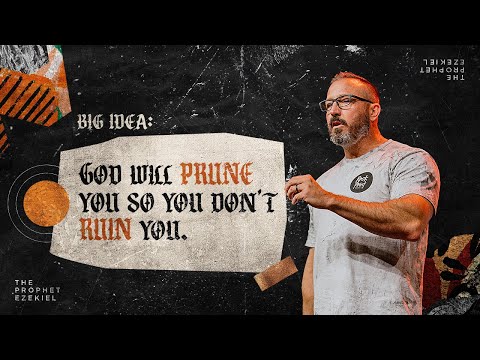
1Ezekiel's exiles and the ones left in Jerusalem went through the same disaster, but for one group it became pruning and for the other it became ruin.
Pastor Bill walks through Ezekiel's message to the exiles in Babylon, explaining that false teachers told the people Jerusalem could never fall because they were God's people. God instead reveals that the exiles are the protected remnant, while those who stayed and refused to listen were heading toward destruction. The same Babylonian invasion was discipline for one group and judgment for the other, depending on whether they trusted God.
2An unproductive vine is only good for burning — God's analogy for a fruitless life.
Reading Ezekiel 15, Pastor Bill shows how God compares Jerusalem to a grapevine that produces nothing useful, unlike a tree that can at least be used for wood; a fruitless vine is fit only for the fire, and if it escapes one fire it will fall into another. He applies this to people stuck repeating destructive patterns, calling it the definition of insanity.
3Out of the pruned remnant, God promises to grow a majestic tree that shelters birds of every kind — a prophecy of Jesus.
Pastor Bill reads Ezekiel 17:22-24, where God promises to take a small branch and grow it into a great tree offering shade to birds of every sort. He explains this as a prophecy that the Savior, Jesus, would come from the saved remnant and that people from every nation would find shelter in Him.
You surrender to God, you win
4Jesus is the true vine, and fruit only comes from remaining connected to Him — not from legalism or license.
Turning to John 15, Pastor Bill reads through Jesus' vine and branches teaching, explaining that dead branches never really belonged to the vine and fruitful branches get pruned to produce more. He contrasts legalism (earning love by rule-keeping) with license (using grace as an excuse to live however you want), insisting the gospel is living FROM Christ's love, which changes you.
Just because you come to church doesn't make you a follower of God anymore than if you sit in your garage makes you a car
5Responding to God's word brings joy, not the happiness that depends on circumstances.
Pastor Bill unpacks John 15:7, clarifying that asking and receiving isn't a formula for getting what makes you happy, but God giving you what you need to obey Him, which produces joy — a peace that holds up regardless of circumstances. He contrasts this with chasing happiness, which is always at the mercy of a broken world.
6Loving the church sacrificially with time and money is the test of whether you actually love Christ.
Pastor Bill presses that loving the church isn't showing up for a service but showing up FOR the church — serving with your gifts and giving financially. He tells the story of the two TVs in his office, one useless and distracting until he finally unplugged it, as a picture of how believers keep convoluted excuses plugged in instead of simply unplugging the useless and loving the church the way Christ asked.
If you want what God wants in your life, you will always always get what you want
Unplug the useless and plug in the useful
are you a fan of Jesus or a follower of Jesus
Illustration
Two TVs on one remote — doing a convoluted dance for two years before simply unplugging the useless TV
7The call is to be rooted in Jesus, not just rooting for Him — family, not fans.
Pastor Bill closes by distinguishing a fan, who cheers for Jesus only when things go well, from family, who stays rooted no matter what. He uses his own story of abandoning the Dodgers as a kid once they stopped winning to illustrate how many people quit on Jesus the moment following Him gets hard, and ties this to remembering Christ's sacrifice through communion.
A story from life
Pastor Bill reflects on being a Dodgers fan as a kid and abandoning them when the team declined — used to illustrate fair-weather fandom versus genuine loyalty
A story from life
Pastor Bill recounts telling church-planting resident Cliff he was not ready to preach, and Cliff's gracious response
Application
Pastor Bill frames the choice as whether you are rooting for Jesus like a fan or rooted in Him as family.
Respond to His word
Whatever God has asked you to do as a disciple and as part of the church, actually do it rather than just agreeing with it in theory; this is where joy, not circumstantial happiness, comes from.
Reach out with sacrificial love
Love the church by showing up for it, not just at it — use your spiritual gifts to serve and give financially as an act of love toward the body of Christ, not as a tip.
Get honest about what you're plugged into
Identify the convoluted excuses or distractions keeping you from loving and serving the church, and unplug them the way Pastor Bill unplugged the useless TV.
Remember Him when it's hard
Expect that following Jesus will be difficult and that the world may not always affirm your faith; take communion regularly as a reset to remember His sacrifice and remain in His love.
Decide if you're rooted or just rooting
Ask yourself honestly whether you are family or just a fan of Jesus, and if you've never truly surrendered to His love, pray right now to confess and trust Him.
Take it into your week
Rewind AI contributed study material from the sermon transcript; church-authored wording and verified sermon quotes keep their own source. Always trust the sermon itself over anything here. How Rewind uses AI