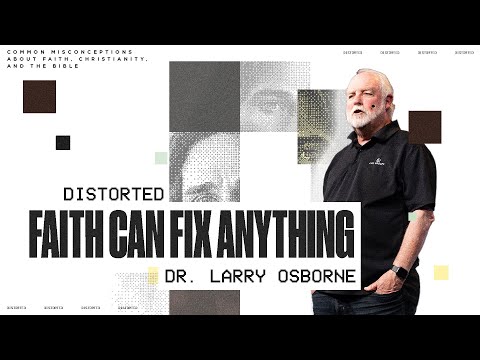
Key points
1Faith has zero inherent power — the power is in what faith is placed in
Pastor Larry debunks the popular idea that faith is a Jedi-like force we harness to change reality. He uses the illustration of skydivers: whether a jumper is confident or terrified doesn't determine whether they survive — it's whether the parachute was packed correctly. In the same way, faith placed in something false won't work, and even weak faith placed in something true will.
The power of faith is not how much you and I can muster up. The power of faith is what we place our faith in
2Biblical faith is simply trusting God enough to do what He says
He walks through how English translations split one Greek word (pistos/pisteuo) into three separate-feeling words — faith, believe, and trust — which has warped our understanding into thinking faith is mainly a feeling or mental fact-check. He tests the room on whether demons believe in Jesus to show that mere mental belief isn't the point; the word carries all three senses together: trust enough to act.
Biblical faith is simply trusting God enough to do what he says
3We cannot please God without faith
He reads Hebrews 11:6, breaking it down to show that faith requires believing God exists and believing He rewards those who sincerely seek Him — not treating God as a distant 'cosmic consultant' but living as though He responds to how we respond.
4Biblical faith has room for doubt and fear, but no room for disobedience
Using the death-row-to-freedom picture of the gospel and the GPS-versus-instinct illustration, he shows that trusting God enough to obey — even confused, scared, or unconvinced — is what faith actually looks like. He tells the story of Peter's rescue from prison in Acts 12, where the praying believers were so full of doubt they didn't believe Rhoda when she said Peter was at the door, yet God still answered because they had simply obeyed the call to keep praying.
Faith and doubt are not opposites. Faith and fear are not opposites. They can coexist
You see, faith is never risky. Disobeying God is risky
A story from life
The preacher's wife was diagnosed with stage-four cancer; they prayed and she recovered, while a friend's wife walked the same path and died
5Faith is never risky — disobedience is risky
He warns against the popular idea that God is impressed by reckless, risky decisions made in His name. Referencing Jesus's teaching on counting the cost before building a tower or going to war, and the stories of the burning bush and Peter walking on water, he argues that stepping out is only rational obedience when God has clearly spoken — not a leap based on a feeling or a hunch.
There's no value in risk. There's value in obedience
6Faith is the map that guides us through the valley, not a power that rescues us from it
He shares that his wife's stage-four cancer battle ended in healing while a friend's identical walk of faith ended in death, showing that faith isn't a formula for guaranteed outcomes. Obedience may lead to victory or it may lead to the cross, and either way faith is proven in the walking, not the winning.
7We don't need more faith — a mustard seed is enough; we need more obedience
He unpacks Jesus's teaching that even a tiny, mustard-seed-sized faith can 'move a mountain,' given in the context of the disciples being told to forgive someone seven times in a day. Jesus wasn't asking for more faith but for simple obedience, illustrated by the raising of Lazarus, where the mourners simply had to hold their nose and roll away the stone before they saw what God would do.
He just wants you to hold your nose and roll away the stone
Application
Pastor Larry's charge is to stop trying to feel your way into faith and just hold your nose and roll away the stone.
Redefine faith in your own mind
Drop the idea that faith is a mental power or a positive-thinking trick, and start seeing it simply as trusting God enough to obey Him, whatever you feel.
Let doubt and fear coexist with obedience
Don't wait to feel confident or certain before obeying God; like the praying believers in Acts 12 or Jesus in Gethsemane, act in obedience even while afraid or unsure.
Stop chasing risk in God's name
Don't mistake reckless decisions for great faith; only step out when God has clearly spoken, not because a leap feels bold or spiritual.
Look for the area you're avoiding
Identify the specific thing you know God wants you to do but you're afraid it won't work out, and take that next step this week regardless of the outcome.
Take it into your week
Rewind AI contributed study material from the sermon transcript; church-authored wording and verified sermon quotes keep their own source. Always trust the sermon itself over anything here. How Rewind uses AI


